Featured Articles

In today’s competitive world, one must be knowledgeable about the latest online bus...
Oct 12, 2018
Are you curious about the future of Business Intelligence?
Which BI trends will transform how we work, and how are leading Business Intelligence software vendors preparing for these changes? If you're interested in how these trends might impact your business, you're in the right place.
Take the example of 2 Brothers Moving & Delivery, a data-driven company that found traditional data tools too complex for their dynamic needs. By partnering with Grow, a notable BI software vendor, they managed to simplify their data processes and make crucial information accessible and engaging for their team. And what is Business Intelligence if not making data easier to manage. Grow BI dashboards helped motivate their staff by making performance metrics clear and actionable.
According to the BARC Data, BI, and Analytics Trend Monitor 2024, the top five BI trends include enhancing data security, improving data quality, cultivating a data-driven culture, strengthening data governance, and increasing data literacy. These trends are reshaping industries worldwide, proving that sophisticated, user-friendly Business Intelligence technologies are becoming essential in today’s data-centric business environment.
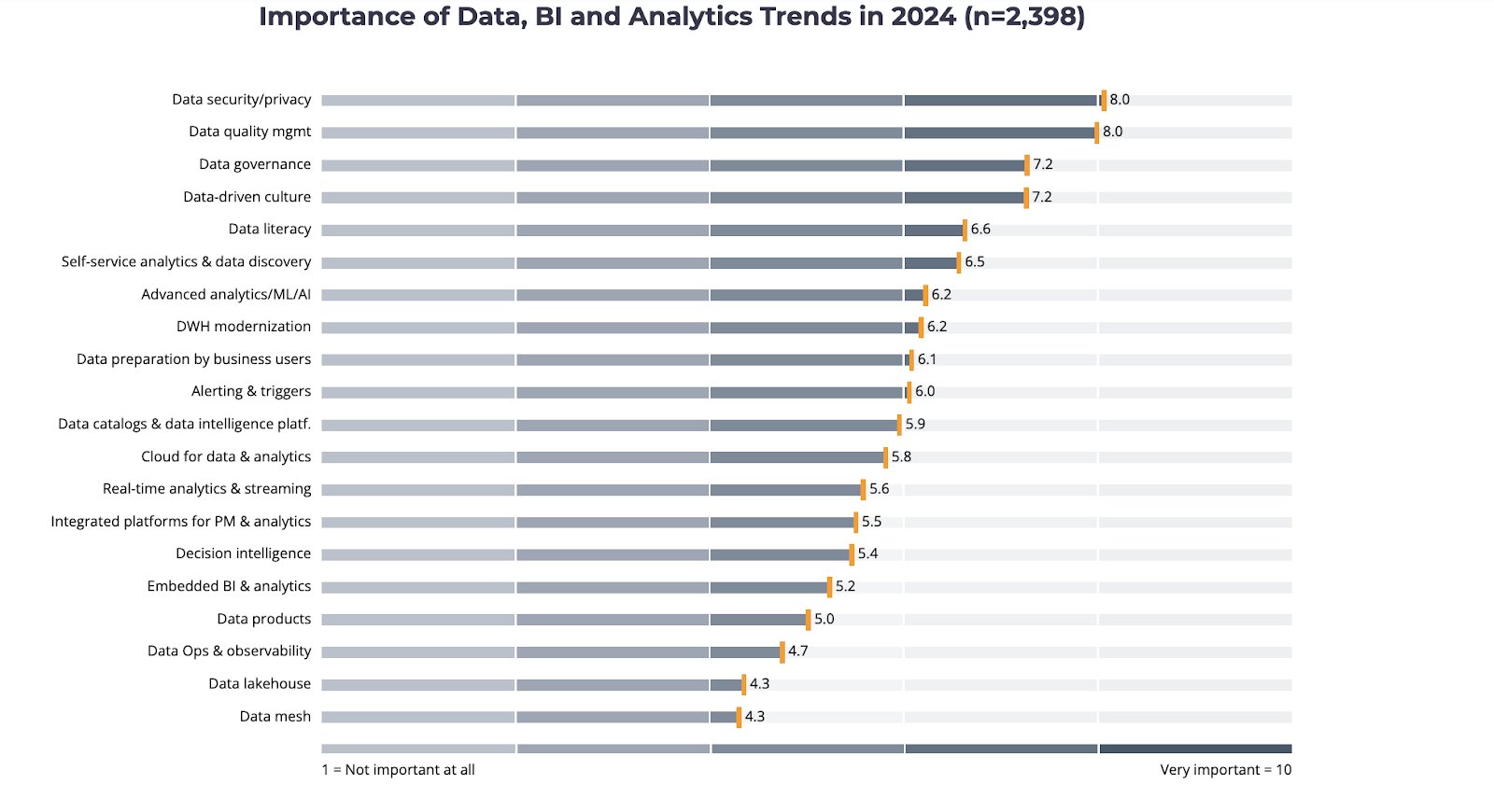
So, what are the game-changing Business Intelligence trends that will shape the next decade?
Let’s move right in!
Game-Changing BI Trends That Will Shape the Next Decade
Trend #1: The Rise of Artificial Intelligence and Machine Learning in BI
AI and ML are increasingly becoming integral to Business Intelligence technologies, enhancing the capabilities of BI software in profound ways. Initially, BI tools primarily focused on descriptive analytics, providing insights into past and current business operations.
However, the introduction of AI and ML in Business Intelligence trends has expanded these capabilities to include predictive and prescriptive analytics, enabling businesses to forecast future trends and effectively plan their strategies.
Modern Business Intelligence software vendors leverage AI algorithms to automate complex data analysis processes, allowing them to handle large volumes of data with speed and accuracy that human analysts cannot match. For instance, Machine Learning models can identify patterns and anomalies in data that might indicate critical business events, such as potential sales declines or operational disruptions.
Key Developments:
- Automated Machine Learning (AutoML): This technology democratizes ML by enabling non-experts to create predictive models without needing extensive programming knowledge, which is a significant advancement touted by leading Business Intelligence software vendors.
- Natural Language Processing (NLP): Integrated into BI systems, NLP allows users to interact with their data in conversational language, making data analytics more accessible to a broader range of business users.
Predictions on AI Advancements in BI for the Next Decade
Looking ahead, the next decade promises even greater integration of AI and ML in Business Intelligence technologies, driven by several emerging trends:
- Explainable AI (XAI): As businesses demand more transparency from AI systems, XAI will become crucial in BI. This advancement aims to make AI decisions more understandable to humans, which is essential for maintaining trust and ensuring compliance with regulatory standards.
- Augmented Analytics: This area will continue to evolve, using AI to automate data insights generation and expanding the accessibility of analytics to non-technical users, thus promoting a data-driven culture throughout organizations.
- Edge AI: With the rise of IoT devices and mobile computing, AI capabilities are being pushed to the edge of the network where data is generated. For BI, this means faster insights with less reliance on central processing, crucial for industries requiring real-time decision-making like manufacturing and logistics.
- Federated Learning: As privacy concerns mount, federated learning offers a way to train AI models on decentralized data, helping businesses comply with data privacy laws while still benefiting from shared machine learning insights.
Trend #2: Increased Emphasis on Data Quality Management
Data quality management in BI refers to the processes involved in ensuring the data is accurate, complete, timely, and consistent across all systems. Quality data must be reliable and should accurately represent the real-world constructs it is supposed to depict. The significance of data quality management in BI has risen sharply with the realization that poor data quality can lead to erroneous conclusions, ineffective business strategies, and potential financial loss.
Predictions for Data Quality Management in BI
- Increased Automation: More tasks related to data quality will be automated using AI and machine learning, making these processes faster and more accurate.
- Tighter Integration with BI Tools: Data quality tools will be more seamlessly integrated into BI platforms, allowing for real-time cleaning and updating of data within BI workflows.
- Stronger Data Governance: As data privacy regulations tighten, organizations will adopt robust data governance frameworks to manage data access, quality, and compliance effectively.
- Data Quality as a Service (DQaaS): Cloud-based data quality services will become popular, offering affordable and scalable solutions for managing data quality without heavy IT investments.
- Focus on Ethical AI: There will be a greater emphasis by Business Intelligence software vendors and BI users on ensuring the data used in AI systems is accurate and unbiased to prevent ethical issues in automated decision-making.
- Proactive Data Quality Measures: Predictive analytics will be used to foresee and address potential data quality issues before they impact BI systems.
- Cross-Organizational Strategies: Companies will collaborate more on data quality initiatives, especially in sectors like supply chains and healthcare, where data sharing is crucial.
- Advanced Visualization Tools: New visualization tools will help businesses monitor and understand data quality more effectively through intuitive and interactive BI dashboards.
Trend #3: The Integration of BI and Blockchain Technology
Blockchain technology operates as a decentralized digital ledger that records transactions across many computers in such a manner that the registered transactions cannot be altered retroactively. This inherent design of blockchain offers two key features for Business Intelligence:
- Security: Due to its cryptographic hashing and decentralization, blockchain significantly reduces the risks of data tampering and cyber-attacks.
- Transparency: Every transaction on a blockchain is visible to all participants and requires consensus before it is recorded, creating an environment of trust and accountability.
Predictions for the Future:
- Widespread Adoption Across Industries: Industries that rely heavily on the credibility and authenticity of data, such as pharmaceuticals, healthcare, and finance, are likely to pioneer the integration of blockchain in their BI systems.
- Enhancement of AI and ML Models: Blockchain could provide a reliable data foundation for AI and ML models, enhancing their accuracy and dependability.
- Regulatory Compliance and Governance: With its ability to maintain secure and transparent records, blockchain will become a key tool in addressing the growing regulatory demands for data privacy and management.
Trend #4: The Expansion of Self-Service BI Tools
Self-service BI tools facilitate the democratization of data by enabling users across various roles within an organization to access, analyze, and utilize data independently. This shift is a critical aspect of modern Business Intelligence trends, moving away from a centralized model where only IT professionals or data analysts handle data queries and reports.
Key Features Supporting Democratization:
- User-Friendly Interfaces: Modern Business Intelligence technologies offer intuitive drag-and-drop interfaces and interactive dashboards that non-technical users can easily navigate.
- Access Controls: These tools provide robust access management features, ensuring data security while allowing diverse user groups to access the data they need.
Predictions for Self-Service BI Tools
- Wider Adoption: More industries, including small businesses and non-profits, will start using self-service BI tools due to their ease of use.
- Smarter Tools: AI and machine learning will be integrated more deeply, making these tools even more user-friendly and capable of performing complex analyses automatically.
- Better Data Management: There will be enhanced features for data governance and quality control to help ensure data accuracy and security.
- Customizable Features: Users will be able to customize and personalize their BI tools more extensively, tailoring them to meet specific needs.
- Enhanced Collaboration: Self-service Business Intelligence technologies will include better features for teamwork, allowing users to share insights and collaborate in real-time, even from remote locations.
- Mobile Enhancements: These tools will become fully functional on mobile devices, supporting decision-making anytime, anywhere.
- Focus on Education: There will be a greater emphasis on educating users in data literacy to ensure they can fully leverage BI capabilities.
- Industry-Specific Tools: More tailored BI solutions will be available for specific industries, making it easier to address unique challenges.
Trend #5: Predictive and Prescriptive Analytics Becoming Mainstream in Business Intelligence
Predictive Analytics primarily focuses on forecasting future events based on historical data. It uses statistical models and machine learning techniques to identify trends, patterns, and potential outcomes. This form of analytics is crucial for scenarios where understanding the likelihood of future occurrences is key, such as demand forecasting in retail or risk assessment in finance.
Prescriptive Analytics goes a step further by not only predicting outcomes but also suggesting courses of action and showing the potential effects of each decision. It combines the insights from predictive analytics with optimization and simulation algorithms to advise on possible outcomes. For example, in supply chain management, prescriptive analytics can suggest the best distribution routes based on anticipated weather conditions, traffic, and cost implications.
Also read, What are the various types of Data Analysis?
Predictions for Predictive and Prescriptive Analytics in BI
- Widespread Use Across Industries: These analytics will be standard in all sectors, not just data-heavy ones like finance or retail.
- Real-Time Analytics: Technologies will evolve to offer instant insights, enabling businesses to make quicker decisions based on current data.
- Integration with IoT Devices: Predictive analytics will be used more with IoT devices to anticipate maintenance needs and optimize operations.
- User-Friendly Tools: Analytics tools will become easier to use, allowing non-experts to perform advanced data analysis.
- Advanced Machine Learning Models: Machine learning models will improve, becoming capable of learning from smaller data sets and providing more precise predictions.
- Focus on Ethical AI: There will be a greater emphasis on ensuring that AI decisions are transparent and adhere to ethical standards.
- Growth of Cloud Analytics: More businesses will access predictive and prescriptive analytics through cloud services, making these tools more accessible.
- Cross-Functional Teams: Companies will form teams that combine IT, data science, and business operations to maximize the use of analytics.
- Industry-Specific Solutions: Custom analytics solutions will be developed to meet the unique needs of different industries.
Trend #6: Ethical AI and Responsible Data Use in Business Intelligence
Ethical AI involves developing and using AI technologies in a manner that is morally sound and respects user rights. In the context of Business Intelligence, ethical AI deployment ensures that decisions made by AI systems are fair, transparent, and accountable. This is crucial as AI systems increasingly handle more decision-making processes in business environments, influencing everything from customer relations to internal operations.
Predictions for Ethical AI and Responsible Data Use in BI
- Stricter Regulations: Expect tougher global laws on data privacy and AI ethics, impacting how businesses use AI.
- Focus on Transparency: Companies will need to be more transparent about how their AI systems work and the data they use.
- Privacy Technologies: Privacy-preserving technologies like federated learning will become more popular, helping businesses use data without compromising individual privacy.
- Ethical AI Roles: New professional roles, such as Ethical AI Officers, will emerge to oversee AI ethics within companies.
- Ethics as Advantage: Businesses with strong ethical AI practices will gain a competitive edge, attracting more customers.
- Ethics Education: Training on AI ethics will become essential in organizations, preparing professionals to integrate ethics into their work.
- Ethical Frameworks: Companies will develop detailed ethical guidelines for AI, ensuring systems are fair and accountable.
- Government Involvement: Expect increased government action in promoting ethical AI through funding and policy-making.
Conclusion
Embracing these game-changing Business Intelligence trends will not only ensure that your organization stays ahead of the curve but also maximizes efficiency, innovation, and competitive advantage in an increasingly data-driven world.
To stay on the leading edge of these developments, consider adopting sophisticated BI tools like Grow. Grow’s platform offers a seamless experience that aligns with the latest Business Intelligence trends, providing tools and features that cater to the evolving needs of modern businesses. Whether you're looking to enhance data quality management, integrate AI into your analytics, or ensure ethical data use, Grow provides a robust solution tailored to your needs.
Don't just take our word for it—check out "Grow Reviews Cost & Features on GetApp" to see how other businesses are benefiting from their features and services. Ready to see how Grow can help transform your business intelligence strategy? Sign up for a 14-day free trial today and start leveraging the power of advanced BI to propel your business forward.
Article source: https://article-realm.com/article/Business/61758-What-Are-the-Game-Changing-BI-Trends-That-Will-Shape-the-Next-Decade.html
Comments
Reviews

Most Recent Articles
- Oct 24, 2026 StaticStop to Exhibit at SMTA Space Coast Expo and Tech Forum by Dinesh Kumar
- Oct 24, 2026 Study Business Analytics in Vietnam: Scope, Top Universities, Fees & Career Prospects by Mahesh Mysto
- Oct 23, 2026 AI-Powered Healthcare Imaging in 2026: How Computer Vision Is Transforming Medical Diagnostics by HyprForge
- Oct 23, 2026 What Factors Affect the Service Life of 304 Stainless Steel Pipes? by Jane Tian
- Oct 23, 2026 Acceptance criteria for 304 stainless steel pipe by Jane Tian
Most Viewed Articles
- 10686 hits Market Overview: Membrane Contactor Industry 2025 by Terra Logistics
- 8597 hits Mist Sprayer Pumps Market Demands, Trends, Industry Analysis, Segmentation by 2032 by ellamrfr
- 6801 hits Next-Gen Connectivity and the Rising Demand for RF Semiconductors by James Cameroon
- 5706 hits Digital Printing Packaging Market by Technology, Application, and Region by James Cameroon
- 4741 hits Flexographic Printing Plates Market Size, Share, Report 2024-32 by ellyse perry
Popular Articles
In today’s competitive world, one must be knowledgeable about the latest online business that works effectively through seo services....
81605 Views

Walmart is being sued by a customer alleging racial discrimination. The customer who has filed a lawsuit against the retailer claims that it...
64071 Views
Are you caught in between seo companies introduced by a friend, researched by you, or advertised by a particular site? If that is...
37364 Views

Facebook, the best and most used social app in the world, has all the social features you need. However, one feature is missing. You cannot chat...
23645 Views
If you have an idea for a new product, you can start by performing a patent search. This will help you decide whether your idea could become the...
14901 Views

Moving becomes easy when you have the right moving accessories. These moving accessories help secure and protect your item by ensuring that no harm...
13270 Views

A lot of us look forward to the result of moving and not the process itself. It is pretty typical behavior, though. As modern people, many things...
13224 Views

Building a custom home is an exciting adventure. It’s your chance to bring your vision to life and create an area that sincerely displays...
12965 Views

Moving from one state, city, or even to a whole different county, is something that is either dictated by choice or circumstance. This is because,...
12088 Views

The report is titled as ‘Recombinant Cell Culture Supplements Market: Opportunity Analysis and Future Assessment 2022-2030’. An...
11870 Views
Statistics
| Members | |
|---|---|
| Members: | 17226 |
| Publishing | |
|---|---|
| Articles: | 79,838 |
| Categories: | 202 |
| Online | |
|---|---|
| Active Users: | 1784 |
| Members: | 1 |
| Guests: | 1783 |
| Bots: | 17041 |
| Visits last 24h (live): | 5730 |
| Visits last 24h (bots): | 47332 |


