Featured Articles

In today’s competitive world, one must be knowledgeable about the latest online bus...
Oct 12, 2018
ASTM A53 is the standard for seamless and welded black iron and hot-dip galvanized steel pipe, established by the American Society for Testing and Materials (ASTM). It is widely used in fluid transportation, structural support, and other fields. Grade A and Grade B are the two most commonly used grades under this standard. Grade A has lower strength and is suitable for general low-pressure and structural applications; Grade B has higher strength and is often used in industrial piping, pressure systems, and more demanding operating conditions.They differ significantly in mechanical properties, process requirements, and applicable scenarios.
What is ASTM A53 Steel Pipe?
ASTM A53 is a carbon steel pipe specification developed by ASTM International, mainly used for general-purpose piping systems. It covers a wide range of applications such as pressure piping, mechanical structures, and fluid transportation, making it one of the most widely used pipe standards in industry.
ASTM A53 pipes are available in both seamless and welded types. Seamless pipes are produced by a piercing and rolling process, resulting in a continuous structure with higher pressure resistance. Welded pipes (ERW) are formed by rolling steel strips into shape and welding the seam, offering higher production efficiency and lower cost, suitable for general pressure conditions.
In practical engineering applications, ASTM A53 steel pipes are commonly used in water supply systems, fire protection piping, HVAC systems, compressed air lines, and structural support. Due to their versatility, complete size range, and cost-effectiveness, they are widely adopted in both commercial and industrial projects.
Introduction to ASTM A53 Grade A and Grade B
Grade A in ASTM A53 represents a lower strength grade with better formability and processability, making it easier to work in bending, welding, and general manufacturing processes. This grade is typically suitable for low-pressure or low-strength piping systems, such as general fluid transport and structural applications.
Grade B has higher mechanical strength and better pressure resistance than Grade A, making it suitable for more complex and demanding industrial conditions. It is the most commonly used grade in the ASTM A53 standard and is widely used in industrial piping systems, pressure pipelines, and the oil and gas industry.
The main differences between Grade A and Grade B are reflected in three aspects: First, the strength difference, with Grade B being significantly higher than Grade A; second, the difference in operating conditions, with Grade A being more suitable for low-pressure environments, while Grade B can be used in medium and high-pressure industrial systems; and finally, the difference in market applications, with Grade B being more widely used and frequently applied in actual engineering projects due to its superior performance.
ASTM A53 Grade A vs Grade B: Key Differences
Mechanical properties are the core difference between Grade A and Grade B, which directly determines the load-bearing and pressure-resistant capabilities of the pipe. Process details are also adjusted according to different performance requirements. Specific parameter comparisons are shown in the table below:
|
Comparison dimension |
ASTM A53 Grade A |
ASTM A53 Grade B |
|
Tensile strength |
Minimum 330 MPa (approximately 48,000 psi) |
Minimum 415 MPa (approximately 60,000 psi) |
|
Yield strength |
Minimum 205 MPa (approximately 30,000 psi) |
Minimum 240 MPa (approximately 35,000 psi) |
|
Elongation |
When the wall thickness is ≤12.7mm, the minimum is 30%; when the wall thickness is greater than 12.7mm, the minimum is 25% |
When the wall thickness is ≤12.7mm, the minimum is 28%; when the wall thickness is greater than 12.7mm, the minimum is 22% |
|
Welding process requirements |
Welded pipe (ERW or furnace welded) has relatively basic weld inspection requirements and is suitable for low-pressure scenarios. |
Welded pipes require stricter weld quality control (such as some requiring ultrasonic testing), while seamless pipes have higher process precision and are suitable for medium and high pressure scenarios. |
|
Heat treatment |
No mandatory heat treatment required, only basic forming performance needs to be guaranteed |
Some thick-walled pipes (wall thickness > 12.7mm) need to be normalized or stress-relief heat treated to improve material stability. |
ASTM A53 Grade A vs Grade B: Application Differences
The difference in scenarios between the two is entirely determined by mechanical properties, with the core being the distinction between "low voltage/light load" and "medium voltage/medium load":
1. ASTM A53 Grade A: Low Pressure, Light Structure Scenarios
Fluid transportation: Suitable for low-pressure and normal-temperature fluids, such as civil tap water pipes, ordinary compressed air pipes (pressure ≤ 1.6MPa), and non-corrosive liquids (such as cooling water), without the need to withstand high-pressure shocks;
Structural support: used for light steel structure frames (such as temporary factory building supports), fence posts, furniture frames, etc., which only need to bear their own weight or slight external forces, and do not require high strength;
Advantages: The cost is 10%-15% lower than Grade B, and it has high processing flexibility (easy to cut and bend), making it suitable for general civilian or light industrial scenarios with bulk purchases.
2. ASTM A53 Grade B: Medium Pressure, Medium Load Critical Scenarios
Fluid transportation: used for medium-pressure fluids or media with a certain temperature, such as urban low-pressure gas pipelines (pressure ≤ 2.5MPa), industrial low-pressure steam pipelines (temperature ≤ 120°C), and mildly corrosive fluids (such as low-concentration salt water), which need to withstand medium pressure and temperature fluctuations;
Structure and machinery: used for small and medium-sized equipment supports (such as machine tool base supports), load-bearing components of low-pressure piping systems (such as pipe elbows and tees), and outdoor load-bearing guardrails (such as parking lot anti-collision guardrails), which need to withstand certain external forces or vibrations;
Advantages: It has better strength and stability. In scenarios where "high-pressure special pipes" (such as ASTM A106) are not required, it can be used as a lower-cost alternative, balancing performance and economy.
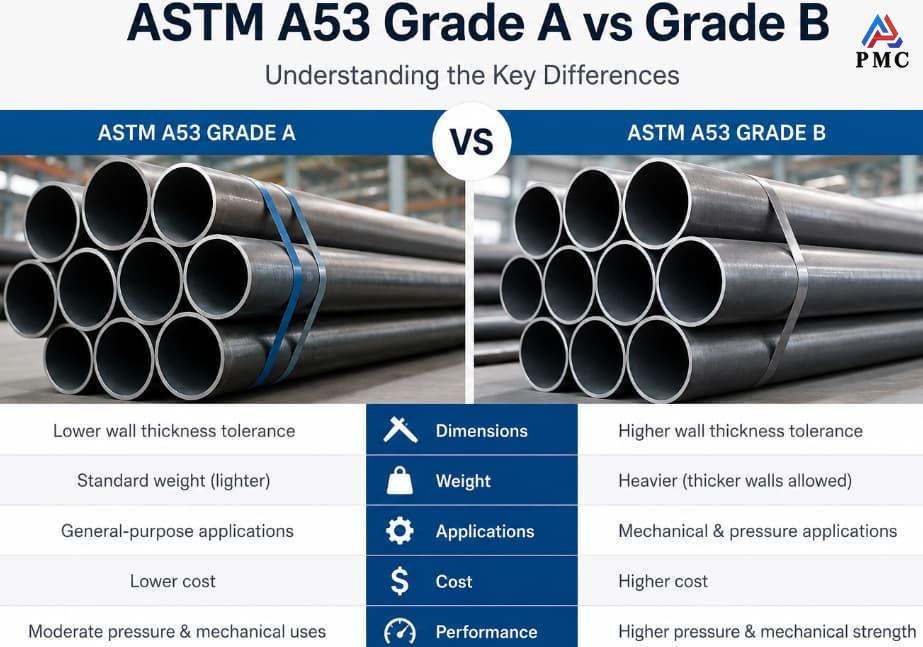
Selection Key: 3 Core Judgment Dimensions
1. Pressure and temperature: if the delivery pressure is ≤1.6MPa and the temperature is ≤80℃, select Grade A; For pressures between 1.6-4.0 MPa and temperatures between 80-120°C, select Grade B. For pressures greater than 4.0 MPa, upgrade to a higher standard (such as ASTM A106).
2. Load type: If the load only bears its own weight or a light static load (such as a fence), select Grade A; if the load bears dynamic loads (such as equipment vibration) or moderate external forces (such as a crash barrier), select Grade B;
3. Cost and cost-effectiveness: Grade A is more cost-effective for general civilian or non-critical industrial scenarios. Grade B should be preferred for scenarios where "failure is not an option," such as medium-pressure transmission and load-bearing structures, to avoid leakage or breakage due to insufficient strength.
Common Characteristics: General Advantages and Standard Requirements
Despite their differences, Grade A and Grade B share the core properties of the ASTM A53 standard:
The material is low carbon steel (carbon content ≤ 0.25%), with excellent welding performance, and can be connected by conventional methods such as arc welding and gas welding;
Both are available in two types: "black tube" (ungalvanized) and "hot-dip galvanized tube". Galvanized tubes can improve corrosion resistance in soil or humid environments and are suitable for buried or outdoor scenes.
The pipe diameter range is consistent (usually 10mm-630mm) and the wall thickness specifications are the same (0.8mm-16mm). You only need to select the grade according to performance requirements without adjusting the installation dimensions.
Conclusion
ASTM A53 Grade A and Grade B are two mainstream low-carbon steel pipe grades for general industrial and civil piping systems. Grade A features superior formability and lower cost, ideal for low-pressure, normal-temperature, and light structural scenarios with static loads. In contrast, Grade B delivers higher tensile and yield strength, stricter manufacturing and testing standards, and better stability, making it suitable for medium-pressure, slightly high-temperature, and dynamic load working conditions. Both grades support seamless and welded types, as well as black and hot-dip galvanized finishes, with unified dimensional specifications. Proper grade selection based on actual pressure, temperature and load requirements helps users balance project safety and procurement economy, avoiding over-specification or material failure risks.
FAQs
Q1: What is the main difference between A53 Grade A and Grade B?
A53 Grade B has higher tensile and yield strength, stricter welding inspection and heat treatment requirements, and is suitable for medium-pressure industrial scenarios, while Grade A is softer, easier to process, and more cost-effective for low-pressure and light structural use.
Q2: Can A53 Grade A replace Grade B?
No. Grade A cannot withstand medium pressure and dynamic loads. It will face leakage and structural failure risks if used instead of Grade B in medium-pressure and vibration working conditions.
Q3: Are A53 pipes available in galvanized type?
Yes. Both Grade A and Grade B support hot-dip galvanization, which greatly improves corrosion resistance for outdoor and buried piping projects.
Q4: When should we choose A106 instead of A53 Grade B?
For working pressure over 4.0MPa or operating temperature above 120°C, high-standard ASTM A106 Gr.B seamless pipes are required for high-temperature and high-pressure industrial systems.
.
Article source: https://article-realm.com/article/Business/83118-ASTM-A53-Grade-A-vs-Grade-B-Pipes.html
URL
https://www.permanentsteel.comPermanent Steel Manufacturing Co.,Ltd have years of experience in manufacturing of carbon steel pipe, stainless steel tube, hollow section, pipe fittings.(Fluid Pipe/Boiler Tube/Fire Pipe/Line Pipe/Structure Tube) Please refer to: https://www.permanentsteel.com
Comments
Reviews

Most Recent Articles
- Oct 24, 2026 Study Business Analytics in Vietnam: Scope, Top Universities, Fees & Career Prospects by Mahesh Mysto
- Oct 23, 2026 AI-Powered Healthcare Imaging in 2026: How Computer Vision Is Transforming Medical Diagnostics by HyprForge
- Oct 23, 2026 What Factors Affect the Service Life of 304 Stainless Steel Pipes? by Jane Tian
- Oct 23, 2026 Acceptance criteria for 304 stainless steel pipe by Jane Tian
- Oct 23, 2026 Food Grade 304 Stainless Steel Pipe vs. Industrial Stainless Steel Pipe by Jane Tian
Most Viewed Articles
- 10684 hits Market Overview: Membrane Contactor Industry 2025 by Terra Logistics
- 8596 hits Mist Sprayer Pumps Market Demands, Trends, Industry Analysis, Segmentation by 2032 by ellamrfr
- 6800 hits Next-Gen Connectivity and the Rising Demand for RF Semiconductors by James Cameroon
- 5704 hits Digital Printing Packaging Market by Technology, Application, and Region by James Cameroon
- 4740 hits Flexographic Printing Plates Market Size, Share, Report 2024-32 by ellyse perry
Popular Articles
In today’s competitive world, one must be knowledgeable about the latest online business that works effectively through seo services....
81601 Views

Walmart is being sued by a customer alleging racial discrimination. The customer who has filed a lawsuit against the retailer claims that it...
64065 Views
Are you caught in between seo companies introduced by a friend, researched by you, or advertised by a particular site? If that is...
37359 Views

Facebook, the best and most used social app in the world, has all the social features you need. However, one feature is missing. You cannot chat...
23641 Views
If you have an idea for a new product, you can start by performing a patent search. This will help you decide whether your idea could become the...
14896 Views

Moving becomes easy when you have the right moving accessories. These moving accessories help secure and protect your item by ensuring that no harm...
13268 Views

A lot of us look forward to the result of moving and not the process itself. It is pretty typical behavior, though. As modern people, many things...
13219 Views

Building a custom home is an exciting adventure. It’s your chance to bring your vision to life and create an area that sincerely displays...
12961 Views

Moving from one state, city, or even to a whole different county, is something that is either dictated by choice or circumstance. This is because,...
12085 Views

The report is titled as ‘Recombinant Cell Culture Supplements Market: Opportunity Analysis and Future Assessment 2022-2030’. An...
11868 Views
Statistics
| Members | |
|---|---|
| Members: | 17225 |
| Publishing | |
|---|---|
| Articles: | 79,837 |
| Categories: | 202 |
| Online | |
|---|---|
| Active Users: | 710 |
| Members: | 1 |
| Guests: | 709 |
| Bots: | 5640 |
| Visits last 24h (live): | 5939 |
| Visits last 24h (bots): | 47651 |


