Featured Articles

Boost Your Website Traffic with High Quality DA/PA 40+ Backlinks
Apr 7, 2023

In today’s competitive world, one must be knowledgeable about the latest online bus...
Oct 12, 2018
1. Quenching + High-Temperature Tempering
This is the go-to process when a pipe needs both strength and toughness at the same time — a combination that's hard to get any other way. The pipe is first heated until its internal structure turns into austenite, then rapidly cooled (quenched) so it transforms into martensite, a very hard but brittle structure. On its own, martensite would be too fragile to use, so it's followed by high-temperature tempering, which softens it slightly and converts it into a more balanced structure called tempered sorbite.
A real-world example helps illustrate why this matters. Pipeline steel like API 5L long-distance oil and gas pipelines that have to survive harsh winters and constant pressure cycling.
The tempering step isn't optional. Right after quenching, a steel pipe is carrying more than 300 MPa of internal stress and is dangerously brittle — a small impact could crack it. Tempering removes over 90% of that stress. Depending on how much hardness needs to be preserved versus how much toughness is required, tempering can be done at low, medium, or high temperature.
2. Normalizing
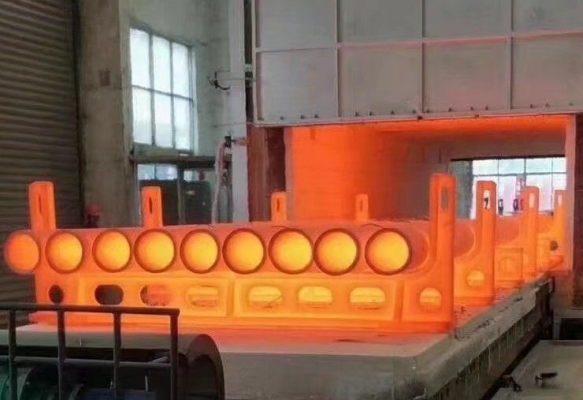
Normalizing looks similar to quenching at first glance — the pipe is heated to a high temperature (roughly 40–60°C above its upper critical point) until it fully turns into austenite — but the cooling step is different. Instead of a rapid quench, the pipe is simply left to cool in open air.
That slower, gentler cooling still refines the grain structure and relieves stress, but without pushing the steel all the way to martensite. Compared with annealing, normalized pipe generally ends up with 20–30% finer grain, 10–20% higher strength, and better machinability, while also avoiding a hot-rolling defect called Widmanstätten structure. It's also faster and cheaper — normalizing typically costs around 60% of what annealing does, mainly because there's no need for slow furnace cooling.
This makes normalizing a common default choice for general-purpose fluid transport pipe, pressure vessel shells, and structural components — anywhere a pipe needs decent strength without the extra cost of a full quench-and-temper cycle.
A simple rule of thumb: if the pipe still needs to go through cold bending or other cold-forming steps, anneal it first — you want it soft. If it's going straight into service, normalize it — you want the extra strength.
3. Normalizing + Tempering
Sometimes normalizing alone isn't quite enough — the pipe is strong, but a bit short on toughness for the application. Adding a tempering step after normalizing addresses that. The steel is heated and air-cooled as usual, then tempered, producing structures like tempered bainite or tempered sorbite depending on the steel grade.
Think of it as sitting between plain normalizing and full quench-and-temper: you give up a small amount of hardness in exchange for noticeably better toughness and dimensional stability, without paying the full cost of a quenching cycle.
4. Annealing
Annealing takes the opposite approach from quenching. The pipe is heated to a moderate temperature — about 30–50°C above its critical point — held there, and then cooled very slowly inside the furnace itself, often at a rate no faster than 50°C per hour. That slow cooling is the whole point: it lets the internal structure relax fully, which is why annealed steel is noticeably softer and easier to work with than normalized or quenched steel.
Because "annealing" covers a fairly wide range of outcomes, it's usually broken down into more specific types — full annealing, spheroidizing annealing, stress-relief annealing, isothermal annealing, and a few others — depending on exactly what the follow-up processing requires. In practical terms, annealing can lower hardness by more than 30%, which makes a real difference when a pipe still needs to be cold-bent, flared, or machined extensively. It's a common choice for precision hydraulic tubing, instrument pipe, and any component that needs a lot of downstream machining.
5. Solution Treatment
Solution treatment is really a stainless steel process, most often used for austenitic grades like 304. The pipe is heated until carbides and alloying elements fully dissolve into the austenite, then quenched quickly enough that those elements don't have time to precipitate back out. What you're left with is a clean, single-phase austenite structure.
This matters because in stainless steel, carbides that form along grain boundaries are exactly what makes the steel vulnerable to corrosion. Solution treatment — typically water quenching from around 1050–1100°C — dissolves those carbides and restores the pipe's corrosion resistance. So while the underlying idea is similar to annealing (heat, then cool to reset the structure), the goal here isn't softness — it's corrosion performance.
6. Surface Quenching
Not every application needs the whole pipe hardened — sometimes only the surface has to stand up to wear, while the core needs to stay tough so the pipe doesn't become brittle overall. Surface quenching does exactly that: only the outer layer is heated to quenching temperature and rapidly cooled, leaving the core structure untouched.
The two most common ways to do this are induction hardening, which uses electromagnetic heating and gives tight control over hardened-layer depth (typically 0.5–10mm) with very little distortion, and flame hardening, which is better suited to localized hardening on large-diameter pipe. A few less common but useful variants exist too — contact resistance heating, electrolytic heating, and laser hardening — each offering a different trade-off between precision, cost, and the size of pipe it can handle.
Done well, surface quenching pushes surface hardness up to HRC 55–60 while keeping the core tough, and can roughly double or triple fatigue strength. That combination is exactly what's needed for hydraulic cylinder barrels, drive shaft sleeves, and wear-resistant pipe used in mining equipment.
7. Chemical Heat Treatment
Chemical heat treatment changes the surface differently — instead of just altering the structure, it actually changes the chemical composition of the surface layer by diffusing other elements into it. Carburizing and nitriding are the two most common versions.
Nitriding in particular is worth calling out because of how little it disturbs the pipe: it causes almost no deformation and can hold tolerances as tight as 0.01mm, which means parts often don't need any further machining afterward. That's a meaningful advantage for precision components where re-machining after heat treatment would be expensive or risky.
8. Special Processes for Extreme Conditions
A couple of processes exist specifically for situations where the standard options aren't quite good enough:
Isothermal quenching holds the pipe at 200–400°C after quenching, allowing a structure called lower bainite to form gradually instead of transforming all at once. This greatly reduces the risk of cracking, which makes it well suited to thick-walled, high-pressure pipe where sudden transformation stresses would otherwise be a real problem.
Aging treatment is more about stability than strength. By holding the pipe at room temperature or a mild 100–200°C for an extended period, dimensions are locked in place so the part won't creep or distort later during service — something that matters a lot in precision applications like aerospace tubing, where even tiny dimensional drift isn't acceptable.
Read full guide: Heat Treatment Processes for Seamless Steel Pipes
Article source: https://article-realm.com/article/Business/84220-Heat-Treatment-Processes-for-Seamless-Steel-Pipes.html
URL
https://www.permanentsteel.com/Permanent Steel Manufacturing Co.,Ltd have years of experience in manufacturing of carbon steel pipe, stainless steel tube, hollow section, pipe fittings.(Fluid Pipe/Boiler Tube/Fire Pipe/Line Pipe/Structure Tube) Please refer to: https://www.permanentsteel.com
Comments
Reviews

Most Recent Articles
- Oct 19, 2026 How E-Commerce Is Expanding the Reach of the Coffee Machine Market by Dipak Straits
- Oct 19, 2026 Affordable Composite Deck Contractor in Johnston, Iowa by Evan
- Oct 19, 2026 Basement Remodeling Experts in Johnston: Plan Smart by Evan
- Oct 19, 2026 Basement Remodeling Experts in Johnston: Plan Smart by Evan
- Oct 19, 2026 Power Up Your UK Business with Next-Gen Crypto Payment Gateway Development by Benjamin Valor
Most Viewed Articles
- 10675 hits Market Overview: Membrane Contactor Industry 2025 by Terra Logistics
- 8587 hits Mist Sprayer Pumps Market Demands, Trends, Industry Analysis, Segmentation by 2032 by ellamrfr
- 6792 hits Next-Gen Connectivity and the Rising Demand for RF Semiconductors by James Cameroon
- 5698 hits Digital Printing Packaging Market by Technology, Application, and Region by James Cameroon
- 4735 hits Flexographic Printing Plates Market Size, Share, Report 2024-32 by ellyse perry
Popular Articles
In today’s competitive world, one must be knowledgeable about the latest online business that works effectively through seo services....
81569 Views

Walmart is being sued by a customer alleging racial discrimination. The customer who has filed a lawsuit against the retailer claims that it...
63865 Views
Are you caught in between seo companies introduced by a friend, researched by you, or advertised by a particular site? If that is...
37342 Views

Facebook, the best and most used social app in the world, has all the social features you need. However, one feature is missing. You cannot chat...
23622 Views
If you have an idea for a new product, you can start by performing a patent search. This will help you decide whether your idea could become the...
14879 Views

Moving becomes easy when you have the right moving accessories. These moving accessories help secure and protect your item by ensuring that no harm...
13254 Views

A lot of us look forward to the result of moving and not the process itself. It is pretty typical behavior, though. As modern people, many things...
13198 Views

Building a custom home is an exciting adventure. It’s your chance to bring your vision to life and create an area that sincerely displays...
12944 Views

Moving from one state, city, or even to a whole different county, is something that is either dictated by choice or circumstance. This is because,...
12067 Views

The report is titled as ‘Recombinant Cell Culture Supplements Market: Opportunity Analysis and Future Assessment 2022-2030’. An...
11569 Views
Statistics
| Members | |
|---|---|
| Members: | 17198 |
| Publishing | |
|---|---|
| Articles: | 79,778 |
| Categories: | 202 |
| Online | |
|---|---|
| Active Users: | 1418 |
| Members: | 4 |
| Guests: | 1414 |
| Bots: | 10126 |
| Visits last 24h (live): | 4618 |
| Visits last 24h (bots): | 31023 |

