Featured Articles

Boost Your Website Traffic with High Quality DA/PA 40+ Backlinks
Apr 7, 2023

In today’s competitive world, one must be knowledgeable about the latest online bus...
Oct 12, 2018
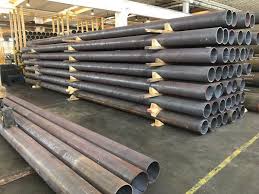
When cold-drawn seamless pipes become rusty, tools such as wire brushes are mainly used to polish the steel surface to remove loose or lifted oxide scale, rust, welding slag, etc. The rust removal of hand tools can reach Sa level, and the rust removal of power tools can reach Sa3 level. If there is a strong iron oxide scale attached to the surface of the steel and the tool rust removal effect is not satisfactory, pickling or spray (throwing) rust removal can be used. method.
1.Pickling
Generally, chemical and electrolytic methods are used for pickling treatment. Cold-drawn seamless pipes only use chemical acid for anti-corrosion.
Washing can remove scale, rust, and old coatings. Sometimes it can be used as a reprocessing after sandblasting and rust removal. Although chemical cleaning can achieve a certain degree of cleanliness and roughness on the surface, the uneven lines are shallow and can easily pollute the environment.
2. Spray (throw) rust removal
Spraying (throwing) rust removal uses a high-power motor to drive the spraying (throwing) blades to rotate at high speed, so that steel sand, steel shots, wire segments, minerals and other abrasives are sprayed (throwing) on the surface of the steel pipe under the action of centrifugal force. , not only can rust, oxides and dirt be completely removed, but the steel pipe can also achieve the required uniform roughness under the action of violent impact and friction of abrasives.
After spraying (throwing) rust removal, it can not only expand the physical adsorption effect on the pipe surface, but also increase the
Strong mechanical adhesion between the anti-corrosion layer and the pipe surface. Therefore, spray (throwing) rust removal is an ideal rust removal method for pipeline anti-corrosion. Generally speaking, shot blasting (sand) rust removal is mainly used for inner surface treatment of pipes, and shot blasting (sand) rust removal is mainly used for outer surface treatment of pipes. Several issues should be paid attention to when using spray (throwing) to remove rust.
(1) Rust removal level
For the construction technology of epoxy, vinyl, phenolic and other anti-corrosion coatings commonly used for steel pipes, the surface of the steel pipe is generally required to reach near white level (Sa2.5). Practice has proven that using this level of rust removal can remove almost all oxide scale, rust and other dirt. The depth of the anchor pattern can reach 40~100μm, which fully meets the adhesion requirements between the anti-corrosion layer and the steel pipe. The rust process can achieve near-white level (Sa2.5) technical conditions with lower operating costs and stable and reliable quality.
(2) Spray (throw) jet grinding technology
In order to achieve the ideal rust removal effect, the abrasive should be selected according to the hardness of the steel pipe surface, the original rust degree, the required surface roughness, the coating type, etc. For single-layer epoxy, two-layer or three-layer polyethylene coatings, use The mixed abrasive of steel sand and steel shot is easier to achieve the ideal rust removal effect. Steel shot has the function of strengthening the steel surface, while steel grit has the function of etching the steel surface. Mixed abrasives of steel grit and steel shot (usually the hardness of steel shot is 40~50HRC, the hardness of steel grit is 50~60HRC, can be used on various steel surfaces, even on C- and D-class rusted steel surfaces. The rust removal effect is also very good.
The particle size and ratio of abrasives are very important in order to obtain better uniform cleanliness and roughness distribution. Too much roughness will easily cause the anti-corrosion layer to become thinner at the peaks of the anchor lines; at the same time, because the anchor lines are too deep, bubbles will easily form in the anti-corrosion layer during the anti-corrosion process, seriously affecting the performance of the anti-corrosion layer. Too small roughness will cause the adhesion and impact strength of the anti-corrosion layer to decrease. For severe internal pitting corrosion, we cannot rely solely on high-intensity impact with large-grain abrasives. We must also rely on small particles to grind away the corrosion products to achieve the cleaning effect. At the same time, reasonable ratio design can not only slow down the wear of the abrasives on the pipes and nozzles (blade) , and the utilization rate of abrasives can also be greatly improved. Usually, the particle size of steel shot is 0.8~1.3mm, and the particle size of steel sand is 0.4~1.0mm, of which 0.5~1.0 mm is the main component. The sand shot ratio is generally 5~8.
It should be noted that in actual operation, the ideal ratio of steel grit and steel shot in the abrasive is difficult to achieve because the hard and brittle steel grit has a higher breakage rate than the steel shot. For this reason, the mixed abrasives should be continuously sampled and tested during operation, and new abrasives should be added to the rust remover according to the particle size distribution. Among the new abrasives added, steel grit should account for the majority.
(3) Rust removal speed
The rust removal speed of cold-drawn seamless pipes depends on the type of abrasive and the displacement of the abrasive, that is, the total kinetic energy applied to the steel pipe by the abrasive per unit time and the kinetic energy of single-grain abrasives. Generally, abrasives with lower loss rates should be selected, which will help increase the cleaning speed and extend the life of the blades.
Article source: https://article-realm.com/article/Business/61586-Rust-removal-of-cold-drawn-seamless-pipes.html
Comments
Reviews

Most Recent Articles
- Oct 23, 2026 Performance of Melamine Board by Chung
- Oct 23, 2026 What Does DN Stand For in Steel Tubes? by Chung
- Oct 22, 2026 Ascorbic Acid Price Forecast 2026: What Will Drive Future Prices? by Rahul Gautam
- Oct 22, 2026 Kuwait Courier Services Expand with Digital Commerce by Akio Komatsu
- Oct 22, 2026 Launch Your Crypto Payment Gateway with the Right Development Partner by Benjamin Valor
Most Viewed Articles
- 10682 hits Market Overview: Membrane Contactor Industry 2025 by Terra Logistics
- 8594 hits Mist Sprayer Pumps Market Demands, Trends, Industry Analysis, Segmentation by 2032 by ellamrfr
- 6798 hits Next-Gen Connectivity and the Rising Demand for RF Semiconductors by James Cameroon
- 5703 hits Digital Printing Packaging Market by Technology, Application, and Region by James Cameroon
- 4738 hits Flexographic Printing Plates Market Size, Share, Report 2024-32 by ellyse perry
Popular Articles
In today’s competitive world, one must be knowledgeable about the latest online business that works effectively through seo services....
81594 Views

Walmart is being sued by a customer alleging racial discrimination. The customer who has filed a lawsuit against the retailer claims that it...
64061 Views
Are you caught in between seo companies introduced by a friend, researched by you, or advertised by a particular site? If that is...
37355 Views

Facebook, the best and most used social app in the world, has all the social features you need. However, one feature is missing. You cannot chat...
23637 Views
If you have an idea for a new product, you can start by performing a patent search. This will help you decide whether your idea could become the...
14892 Views

Moving becomes easy when you have the right moving accessories. These moving accessories help secure and protect your item by ensuring that no harm...
13264 Views

A lot of us look forward to the result of moving and not the process itself. It is pretty typical behavior, though. As modern people, many things...
13213 Views

Building a custom home is an exciting adventure. It’s your chance to bring your vision to life and create an area that sincerely displays...
12958 Views

Moving from one state, city, or even to a whole different county, is something that is either dictated by choice or circumstance. This is because,...
12082 Views

The report is titled as ‘Recombinant Cell Culture Supplements Market: Opportunity Analysis and Future Assessment 2022-2030’. An...
11864 Views
Statistics
| Members | |
|---|---|
| Members: | 17219 |
| Publishing | |
|---|---|
| Articles: | 79,824 |
| Categories: | 202 |
| Online | |
|---|---|
| Active Users: | 1768 |
| Members: | 3 |
| Guests: | 1765 |
| Bots: | 11924 |
| Visits last 24h (live): | 5873 |
| Visits last 24h (bots): | 53510 |


