Featured Articles

In today’s competitive world, one must be knowledgeable about the latest online bus...
Oct 12, 2018
1. Quick Answer: How to Choose ASTM A53 Pipe
To choose the right ASTM A53 pipe, consider the following factors:
Pipe Size: Select based on flow requirements
Schedule (Wall Thickness): SCH 40 for general use, SCH 80 for high pressure
Grade: Grade B is the most commonly used
Type: ERW for cost efficiency, seamless for high performance
Application: Match pipe specs with pressure and temperature
Choosing the correct ASTM A53 pipe ensures safety, durability, and cost efficiency.
2. What is ASTM A53 Pipe?
ASTM A53 pipe is a carbon steel pipe designed for general-purpose and low to medium pressure applications, including water, gas, and air transport.
It is widely used in structural and mechanical systems due to its strength, durability, and cost-effectiveness.
Types of ASTM A53 Steel Pipe:
ERW (Electric Resistance Welded)
Seamless
ASTM A53 pipe is commonly selected for its versatility, reliable performance, and economical price, making it one of the most widely used carbon steel pipe standards.
3. Key Factors to Consider When Choosing ASTM A53 Pipe
3.1 A53 Pipe Size (Diameter & Thickness)
Pipe size is a key factor in selecting ASTM A53 pipe, as it affects flow capacity, system efficiency, and pressure performance.
In pipe standards, NPS (Nominal Pipe Size) defines the pipe size, while the Outer Diameter (OD) remains fixed. The wall thickness (SCH 40 / SCH 80) determines strength and pressure resistance.
NPS is a standard size designation, OD is a fixed external measurement, and wall thickness controls how much pressure the pipe can handle.
Larger diameter = higher flow capacity and lower pressure loss
Thicker wall = higher pressure resistance and strength
Smaller diameter = better flow control in compact systems
Overall, selecting the right pipe size ensures a balance between flow efficiency, strength, and safety in industrial piping systems.
3.2 A53 Pipe Schedule (SCH 40 vs SCH 80)
Pipe schedule refers to the wall thickness of a pipe, which directly affects its strength and pressure resistance.
| Feature | SCH 40 | SCH 80 |
| Wall Thickness | Standard | Thicker |
| Strength | Medium | High |
| Pressure | Moderate | High |
| Application | General use | High pressure |
Use SCH 40 for standard, low to medium pressure applications
Use SCH 80 for high-pressure and heavy-duty systems
Overall, SCH 80 provides greater durability and pressure capacity, while SCH 40 is more cost-effective for general use.
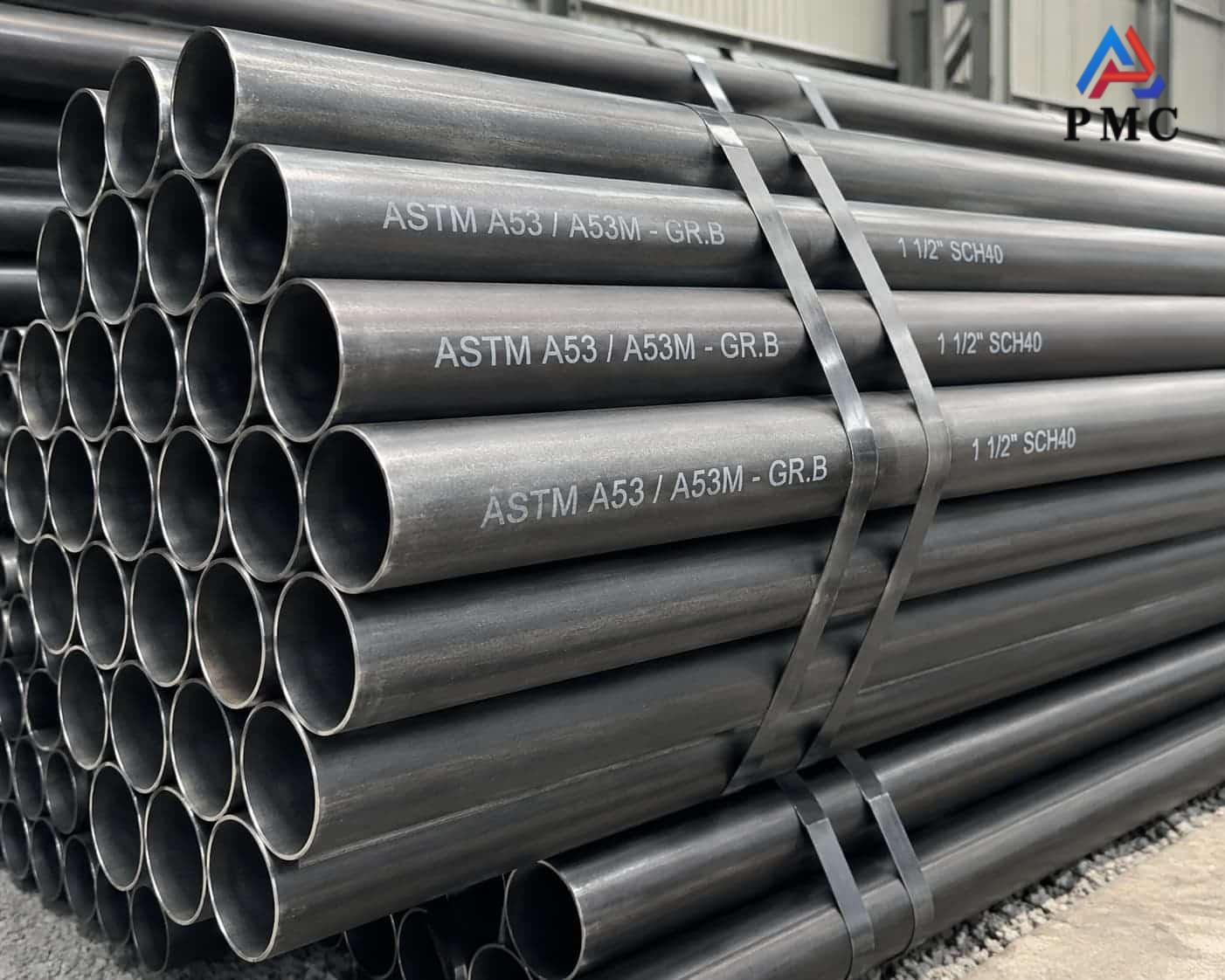
3.3 A53 Pipe Grade (Grade A vs Grade B)
| Grade | Strength | Usage |
| Grade A | Lower | Limited |
| Grade B | Higher | Widely used |
Grade B offers higher tensile strength and better mechanical performance, making it more suitable for most piping systems, including structural and pressure applications.
Recommendation:
ASTM A53 Grade B is the preferred choice for most applications due to its higher strength, better durability, and wider usability in industrial systems.
3.4 Manufacturing Type (ERW vs Seamless)
The manufacturing process of ASTM A53 pipe directly affects its strength, performance, and cost.
| Type | Advantages | Use Case |
| ERW | Lower cost | General applications |
| Seamless | Higher strength | High pressure systems |
ERW pipes are produced by welding steel strips, making them more economical and widely used in standard piping systems. Seamless pipes are manufactured without a weld seam, offering better strength and reliability under high-pressure conditions.
ERW = cost-effective for general use
Seamless = higher strength for demanding applications
Overall, the choice depends on balancing cost efficiency and performance requirements.
3.5 Application Requirements
ASTM A53 pipe should always be selected based on specific project requirements, including pressure level, structural demand, and operating environment.
Low-pressure systems → SCH 40 ERW pipe is commonly used for water, air, and general utility lines
High-pressure systems → SCH 80 seamless pipe is preferred for improved strength and safety
Structural applications → Grade B pipe is widely used due to its higher mechanical strength
Different combinations of grade, schedule, and manufacturing type determine overall performance and suitability.
Matching pipe specifications to the correct application is essential for ensuring safety, efficiency, and long-term reliability in piping systems.
4. ASTM A53 Pipe Selection Chart (Quick Reference)
This chart provides a fast overview of how to select ASTM A53 pipe based on common engineering requirements such as pressure level, structural demand, budget, and system criticality.
| Requirement |
Recommended Option |
| Low pressure systems | SCH 40 |
|
High pressure systems |
SCH 80 |
| Structural applications | Grade B |
| Budget projects | ERW |
| Critical systems | Seamless |
Overall, selecting the right combination of schedule, grade, and manufacturing type is essential to ensure safety, performance, and cost efficiency in piping systems.
5. Common Mistakes When Choosing ASTM A53 Pipe
Selecting the wrong ASTM A53 pipe can lead to poor performance, safety risks, and higher long-term costs.
Common mistakes include:
Choosing based on price only, without considering performance requirements
Ignoring pressure and temperature conditions of the system
Selecting incorrect pipe size, leading to flow inefficiency or pressure loss
Not considering actual application environments (structural, fluid, or gas systems)
Proper evaluation of pressure, size, grade, and application type is essential to ensure safe and efficient pipe performance.
6. FAQs
Q1: What is ASTM A53 pipe used for?
ASTM A53 pipe is used for fluid transport, structural applications, and low-pressure systems such as water, gas, and air pipelines.
Q2: How do I choose ASTM A53 pipe size?
Choose pipe size based on flow requirements, system pressure, and application type.
Q3: What is the difference between SCH 40 and SCH 80?
SCH 80 has a thicker wall and higher pressure resistance than SCH 40.
Q4: Which ASTM A53 grade is best?
Grade B is the most widely used due to its higher strength and better.
Q5: Is ASTM A53 suitable for high pressure?
ASTM A53 is suitable for moderate pressure. For high pressure or high temperature, ASTM A106 is recommended.
7. Conclusion
Choosing the right ASTM A53 pipe depends on a combination of key factors, including pipe size, schedule (wall thickness), grade, manufacturing method, and specific application requirements.
Use Grade B for most general and industrial applications due to its higher strength and reliability
Choose SCH 40 for standard, low to medium pressure systems
Choose SCH 80 for high-pressure and heavy-duty applications
Use ERW pipes for cost-effective solutions in general-purpose projects
Use Seamless pipes for critical systems requiring higher strength and safety
Proper selection of ASTM A53 pipe ensures improved system performance, higher operational safety, and better long-term cost efficiency.
Article source: https://article-realm.com/article/Business/83486-How-to-Choose-ASTM-A53-Pipe-Size-and-Grade-Guide.html
URL
https://www.permanentsteel.com/Permanent Steel Manufacturing Co.,Ltd have years of experience in manufacturing of carbon steel pipe, stainless steel tube, hollow section, pipe fittings.(Fluid Pipe/Boiler Tube/Fire Pipe/Line Pipe/Structure Tube) Please refer to: https://www.permanentsteel.com
Comments
Reviews

Most Recent Articles
- Oct 23, 2026 AI-Powered Healthcare Imaging in 2026: How Computer Vision Is Transforming Medical Diagnostics by HyprForge
- Oct 23, 2026 What Factors Affect the Service Life of 304 Stainless Steel Pipes? by Jane Tian
- Oct 23, 2026 Acceptance criteria for 304 stainless steel pipe by Jane Tian
- Oct 23, 2026 Food Grade 304 Stainless Steel Pipe vs. Industrial Stainless Steel Pipe by Jane Tian
- Oct 23, 2026 Square Tube Weight Formula by Jane Tian
Most Viewed Articles
- 10684 hits Market Overview: Membrane Contactor Industry 2025 by Terra Logistics
- 8596 hits Mist Sprayer Pumps Market Demands, Trends, Industry Analysis, Segmentation by 2032 by ellamrfr
- 6800 hits Next-Gen Connectivity and the Rising Demand for RF Semiconductors by James Cameroon
- 5704 hits Digital Printing Packaging Market by Technology, Application, and Region by James Cameroon
- 4740 hits Flexographic Printing Plates Market Size, Share, Report 2024-32 by ellyse perry
Popular Articles
In today’s competitive world, one must be knowledgeable about the latest online business that works effectively through seo services....
81600 Views

Walmart is being sued by a customer alleging racial discrimination. The customer who has filed a lawsuit against the retailer claims that it...
64065 Views
Are you caught in between seo companies introduced by a friend, researched by you, or advertised by a particular site? If that is...
37359 Views

Facebook, the best and most used social app in the world, has all the social features you need. However, one feature is missing. You cannot chat...
23640 Views
If you have an idea for a new product, you can start by performing a patent search. This will help you decide whether your idea could become the...
14894 Views

Moving becomes easy when you have the right moving accessories. These moving accessories help secure and protect your item by ensuring that no harm...
13266 Views

A lot of us look forward to the result of moving and not the process itself. It is pretty typical behavior, though. As modern people, many things...
13217 Views

Building a custom home is an exciting adventure. It’s your chance to bring your vision to life and create an area that sincerely displays...
12960 Views

Moving from one state, city, or even to a whole different county, is something that is either dictated by choice or circumstance. This is because,...
12084 Views

The report is titled as ‘Recombinant Cell Culture Supplements Market: Opportunity Analysis and Future Assessment 2022-2030’. An...
11868 Views
Statistics
| Members | |
|---|---|
| Members: | 17224 |
| Publishing | |
|---|---|
| Articles: | 79,832 |
| Categories: | 202 |
| Online | |
|---|---|
| Active Users: | 751 |
| Members: | 0 |
| Guests: | 751 |
| Bots: | 5541 |
| Visits last 24h (live): | 6499 |
| Visits last 24h (bots): | 49268 |
