Featured Articles

In today’s competitive world, one must be knowledgeable about the latest online bus...
Oct 12, 2018
COVID-19 pandemic has changed our life in several ways. We witnessed a surge in technology-led adoptions across several industries to prioritize convenience and accessibility over every other aspect. The overall impact has been positive as different industries and services have gone digital, benefitting the masses with fast and easy accessibility to products and services. These digital initiatives helped the healthcare sector attain a digital infrastructure at a very fast pace. Healthcare app development companies also contributed in attaining this feat. Esteemed app development companies like Biz4solutions have in-house healthcare app developers who are ready to help a healthcare provider of any capacity to uplift its brand recognition with robust and user-friendly applications. Basically, the pandemic exposed the bottlenecks of the operations and supply chain in the healthcare sector, helping the healthcare providers to fill the gaps and boost the infrastructure with digital offerings. We have seen a slew of changes and upgrades in the healthcare sector which are here to benefit us in the long term.
Different Ways of Digital Transformation in Healthcare Sector:
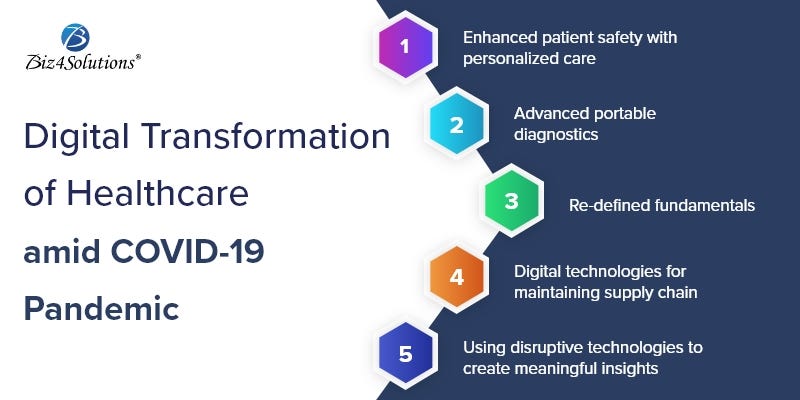
1. Enhanced patient safety with personalized care
Amid the pandemic situation, everyone went through a period of anxiety and doubts over visiting a healthcare facility and meeting a doctor in person. The healthcare centers and hospitals started remote patient engagement programs to mitigate this escalating anxiety in people. Digitalization of healthcare introduced telemedicine, one of the best technological advancements in the healthcare sector. It enables people to get timely medical assistance. In the bid to solve COVID-related medical issues, we have solved the issues faced by the general public in terms of convenience, long-distance, and long wait time. The telemedicine application saves time and reduces the footfall in any hospital, curbing any further COVID infection caused by close proximity.
The healthcare providers revived their medical infrastructure to integrate emails, texts and voice messages in their system to keep a tab on the surging telemedicine usage. These providers were also entrusted with the task of educating millions of people about the pandemic and recording all the related symptoms and updates. This humungous task wouldn’t have been possible without swiftly upgrading the digital infrastructure. There was a surge in messages and reminders regarding COVID-related precautions which was carefully handled with digital capabilities.
2. Advanced portable diagnostics
With the digitalization of healthcare, imaging modalities evolved. However, the adoption of portable imaging solutions escalated amid the pandemic situation when the hospitals started flooding with COVID patients. Portable ultrasound was used to facilitate competent healthcare in emergency departments and makeshift triage tents. These handheld ultrasound systems were used by medical professionals to assess different health conditions such as acute pneumonia to provide immediate medical assistance. Digital capabilities made diagnostics available to large masses in the troubled times.
3. Re-defined fundamentals
The fundaments of the healthcare sector had to be re-thought to support the digitalization of healthcare to provide faster service to patients. These fundamentals can be divided into different aspects.
- New presets and protocols
The steep rise in the number of COVID patients led to an acute shortage of medical professionals and technicians. The protocols of using different medical equipment such as radiology equipment were changed to introduce easy-to-follow protocols to help the medical professionals scan the suspected COVID patients at a faster pace. Such initiatives were aimed to get a quality and consistent image for the first-time diagnosis to escalate the speed of treatment. Medical strategies were designed to adopt digital strategies for medical diagnostics to fasten every process.
- Real-time virtual collaboration
Different medical professionals including radiologists, oncologists, and cardiologists started working from home. To facilitate a smooth functioning with remote working, many PACS workstations and tele-ultrasound platforms were introduced to empower the remote working professionals with the ability to access and read test reports, images, etc from home. We witnessed a major example of the digitalization of healthcare in pathology with new regulations in the wake of the COVID-19 pandemic. The digitized workflows in the pandemic gave way to new forms of collaboration that scaled the productivity of healthcare institutions.
- Better integration with centralized data centers
To handle the increasing chaos in the healthcare centers, centralized command centers were installed to facilitate better governance. These centers are used to integrate data from all the departments to take fast decisions in real-time. Using these centralized systems, the operational and management team worked in coordination to effectively respond to emergencies and uncertain situations. Digitalization of health records and their remote accessibility has significantly improved the capabilities of analytics and real-time decision-making.
4. Digital technologies for maintaining supply chain
For many decades vaccines were administered on a need basis. The COVID-19 pandemic raised many challenges related to transportation, storage, and vaccine equity for the masses. To deal with these logistical challenges, the stakeholders started seeking solutions using digital technologies. Digitalization of healthcare led to the adoption of digital supply chain management systems that brought all the functionaries across different operations on one page, enabling a smooth procurement, storage, and administration of vaccines.
5. Using disruptive technologies to create meaningful insights
Advanced technologies such as Artificial intelligence were successfully used to identify the body parts infected with the virus using different data feeds such as CT scans and blood reports. Many hospitals employed AI to trace the progress of any disease and take effective measures to curb it.
The fast-paced adoption of digital technologies across the healthcare sector has led to a user-friendly digital transformation wherein the healthcare systems have become more resilient and modern. These digital transformations are set to empower the healthcare system with a fundamentally strong infrastructure.
Long-Term Impact of the Digital Transformation
- Transformed customer relationship: The digitized and remotely accessible healthcare facilities are enabling healthcare institutions to provide customer-centered service, gaining more loyalty and trust.
- Higher Return on Investments: The digital transformation is an ongoing process and many more milestones are yet to be achieved. All of these transformations will yield a higher Return on Investment (ROI) in the long term.
- Resilience: The pandemic rattled the conventional supply chain, following which modifications and upgrades were introduced to create a robust healthcare system ready to serve the masses. These improvements will make the healthcare infrastructure ready to deal with pandemic-like situations in the future.
- Digital leadership and governance: The centralized portals and data-sharing capabilities can be used to develop a governance structure aligned to the business strategy and long-term goals.
- Improved workforce utilization: The digital capabilities will help the management to efficiently allocate resources across the supply chain and operations to derive maximum value from it.
The digital transformation of healthcare industry is mid-way and many more digital capabilities are to be integrated into the existing healthcare infrastructure. The players and stakeholders of the ecosystem need to come together and collaborate to understand how digital technologies can enhance user experience. It can be used to derive better pricing, a resilient supply chain, improved drug development processes, and enhanced user experience. The COVID-19 pandemic has helped the healthcare system enter a new era of digital and smart capabilities. The road ahead is long and progressive, leading towards excellence and affordability.
Article source: https://article-realm.com/article/Sports-Recreation/26070-Digital-Transformation-of-Healthcare-amid-COVID-19-Pandemic.html
Comments
Reviews

Most Recent Articles
- Oct 12, 2026 Experience Reliable Performance With MmoGah Online Game Servers Worldwide by drasloom
- Oct 12, 2026 Get More F14 Gil Through MmoGah For Your Favorite Activities by drasloom
- Aug 21, 2026 Why Women’s Asia Cup 2026 Could Be a Major Event for Online Cricket Fans by Michael Wootton
- Jul 28, 2026 Global Sports Car Market Outlook: Size, Trends, and Growth Prospects by coherentmarketinsights
- Jul 19, 2026 Shark Diving – Is It Safe? by Anna Paquin
Most Viewed Articles
- 5222 hits Difference Between Private And Public Cord Blood Banking by avantika singh
- 5064 hits Guide to choosing a Spa by Jaroinn Ms
- 4163 hits Tips and Tricks by peterjohnee
- 3199 hits Generic Viagra Proving To Be an Effective Solution to Cure Erectile Dysfunction by Guest
- 2860 hits Careprost Eye Drops For Eyelashes by stella harlow
Popular Articles
In today’s competitive world, one must be knowledgeable about the latest online business that works effectively through seo services....
81605 Views

Walmart is being sued by a customer alleging racial discrimination. The customer who has filed a lawsuit against the retailer claims that it...
64071 Views
Are you caught in between seo companies introduced by a friend, researched by you, or advertised by a particular site? If that is...
37364 Views

Facebook, the best and most used social app in the world, has all the social features you need. However, one feature is missing. You cannot chat...
23645 Views
If you have an idea for a new product, you can start by performing a patent search. This will help you decide whether your idea could become the...
14901 Views

Moving becomes easy when you have the right moving accessories. These moving accessories help secure and protect your item by ensuring that no harm...
13270 Views

A lot of us look forward to the result of moving and not the process itself. It is pretty typical behavior, though. As modern people, many things...
13224 Views

Building a custom home is an exciting adventure. It’s your chance to bring your vision to life and create an area that sincerely displays...
12965 Views

Moving from one state, city, or even to a whole different county, is something that is either dictated by choice or circumstance. This is because,...
12088 Views

The report is titled as ‘Recombinant Cell Culture Supplements Market: Opportunity Analysis and Future Assessment 2022-2030’. An...
11870 Views
Statistics
| Members | |
|---|---|
| Members: | 17226 |
| Publishing | |
|---|---|
| Articles: | 79,838 |
| Categories: | 202 |
| Online | |
|---|---|
| Active Users: | 1633 |
| Members: | 1 |
| Guests: | 1632 |
| Bots: | 15803 |
| Visits last 24h (live): | 5773 |
| Visits last 24h (bots): | 47377 |